A weekend RV trip exposes what a power station can and cannot do. You have limited room, limited charging windows, and just enough appliances to punish the wrong buying choice before Saturday night.
That is why this comparison is not really about brand prestige. It is about how each unit fits the rhythm of short off-grid travel, where setup time, recharge speed, and carry weight matter almost as much as raw battery capacity.
For most shoppers, the realistic cross-shop lands around the 1 kWh class. In that lane, EcoFlow DELTA 3 Plus and BLUETTI AC180 make the most sense, but they solve the same problem in noticeably different ways.

What matters on an RV weekend
RV weekends reward gear that disappears into the trip. A battery unit may look strong on a product page, then feel awkward once you start moving it in and out of storage, topping it up between stops, and sharing outlets across real devices.
Weight and footprint change the experience
DELTA 3 Plus is lighter and slimmer than AC180, which matters more in an RV than it does at home. A smaller footprint is easier to stash near a dinette bench, under a seat, or beside other packed gear without forcing constant reshuffling.
Recharging between stops is a real advantage
Short trips rarely give you endless recovery time. EcoFlow’s faster AC charging and its optional 800W alternator charging setup make more sense for RV travel because the unit can recover while you drive instead of waiting for a long campsite recharge window.
Solar still matters on a short trip
Solar input is not just for long boondocking stays. It is also a way to stretch a weekend without hunting for hookups. EcoFlow allows up to 1000W solar input, while BLUETTI AC180 tops out at 500W, which changes midday recovery potential.
Usable output matters more than brochure language
Both models sit at 1800W rated AC output, which covers a realistic weekend mix of chargers, fans, coffee gear, a TV, or a compact appliance. In practice, the larger difference is not raw output but how quickly the battery gets ready again.
Where EcoFlow feels more RV-ready
EcoFlow is easier to recommend for RV weekends because the feature mix lines up with how people actually travel. The capacity is not higher than every rival, but the package is tuned for frequent movement, faster recovery, and easier scaling later.
A power station becomes much more useful in an RV once it can cover more than one charging path. That is where DELTA 3 Plus pulls ahead. AC charging, solar, generator support, and an 800W alternator charger create a more flexible travel setup.
- Charge before departure if you have shore power.
- Recover while driving if your route is long enough.
- Use solar at camp to slow the battery drain instead of starting every morning from zero.
How BLUETTI makes its case
BLUETTI AC180 remains a serious option because it gives you slightly more battery on paper at 1152Wh, and it keeps the buying decision simple. For some RV owners, that is enough. They want one box, one routine, and no expansion planning.
The bigger battery is real, but not the whole story
AC180 does offer more stated capacity than DELTA 3 Plus. That helps if your trip is mostly parked usage and you value longer runtime from a single charge. Still, the advantage narrows once recharge speed and solar intake start shaping the whole weekend.
Its charging profile still works for many camps
BLUETTI lists up to 1440W AC input and around one hour to full recovery in its fast-charge messaging, which is solid. For buyers who recharge mostly from campground power or household AC before departure, that may be all they need.
The tradeoff is weight and portability
AC180 weighs about 35.3 pounds, while DELTA 3 Plus comes in around 27.6 pounds. That gap is not cosmetic. In an RV, you feel it every time the unit moves from garage shelf to vehicle floor, or from inside storage to a picnic table.
A side-by-side view
Spec sheets do not choose a power station for you, but they do reveal what each company optimized. EcoFlow looks more travel-flexible. BLUETTI looks more straightforward if you care most about one-box runtime and do not expect the setup to evolve.
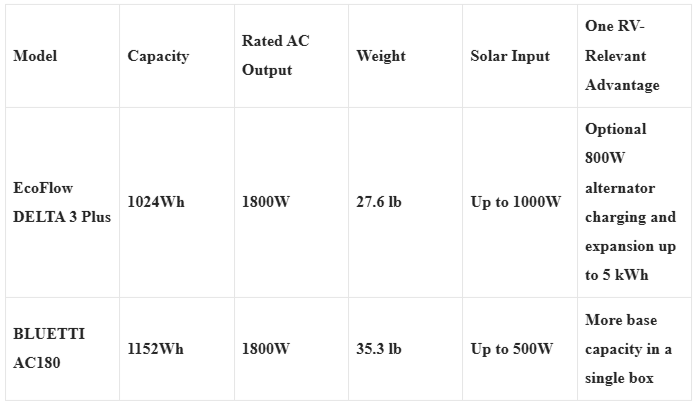
One more detail matters for mixed RV use. EcoFlow also supports expansion from 1 kWh to 5 kWh with compatible batteries, which gives weekend buyers a path upward. BLUETTI AC180 makes less sense if you already suspect your needs will outgrow one fixed-capacity unit.
Which buyer each brand suits
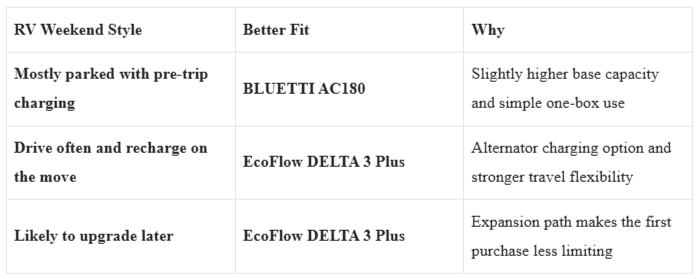
The better RV weekend power station is the one that matches your travel pattern, not the one with the cleanest spec card. This is really a choice between a more flexible travel system and a more self-contained battery box.
BLUETTI works well for simple camp routines
If your weekends are mostly static, your loads are modest, and you recharge from shore power before or after the trip, AC180 stays attractive. The extra base capacity may feel reassuring, especially if you want fewer accessory decisions and less system planning.
EcoFlow fits mixed-use RV routines better
If your trip includes driving days, uncertain hookups, or shifting plans, EcoFlow makes more sense. The lighter body, stronger solar ceiling, and alternator charging option fit the reality of weekend RV travel, where battery recovery often happens in pieces, not in one perfect block.
The tie-breaker is future use
A lot of buyers say they only need weekend power, then later add tailgates, backup power at home, or longer off-grid stops. EcoFlow is easier to grow into because DELTA 3 Plus can move from short-trip tool to a broader battery platform.
The short answer
If your RV weekends are simple and you value a bit more battery in one box, BLUETTI AC180 is easy to justify. It is a competent choice and does not ask much from the buyer.
If you want the better long-term pick, EcoFlow DELTA 3 Plus is stronger. It is lighter, more adaptable, easier to recharge in transit, and better suited to the way short off-grid trips actually unfold. That makes it the more practical power station for most RV weekend buyers.